

D M C : ค้นหาหนังสือธรรมะ หน้า 116 / 265
หน้าหนังสือทั้งหมด
40
Understanding Dhammakāya in Aṅgāṇā-sutta
In brief, contemporary academics refer to the term dhammakāya in the Aṅgāṇā-sutta either as a noun or an adjective. As a noun, the term is interpreted mostly as the Buddha’s teachings collected togeth
The term dhammakāya is interpreted in contemporary academia as both a noun and an adjective. As a noun, it denotes the Buddha’s teachings, while as an adjective, it refers to the nature of the Tathāga
44
Qualities of a Stream-Attainer in Buddhism
mentioned in the canon.40
The title ‘son of the Blessed one’ suggests that, through the
Buddha, the person was (re)born to the same plane (bhūmi) to which
the Buddha belongs, i.e., passing beyond the
This text delves into the characteristics of a Stream-attainer, identified as a noble disciple who is reborn to a transcendental plane through the Buddha's teachings. Key qualities include association
46
Buddhism and the Concept of Nirvāṇa
**43** This is, perhaps, as Eliade observes, ‘for the Buddha, one can be ‘saved’ only by attaining nirvāṇa - that is, by going beyond the plane of profane human experience and re-establishing the plan
Eliade suggests that for the Buddha, salvation comes through attaining nirvāṇa, transcending the mundane aspects of human life and entering an unconditioned state. This transformation entails a metaph
57
The Concept of Dhamma and Kāya in Buddhist Philosophy
On the whole, it appears that the terms dhamma and brahma constituting four designations of the Tathāgāta are used in the sense of the ‘highest.’ It is most likely that they refer to Nibbāna.
This i
This study examines the terms dhamma and brahma, suggesting that they refer to the highest aspect of Tathāgāta, likely Nibbāna. The term dhamma denotes transcendental realities, transcending the realm
76
Understanding the Terms Kevala and Dhammakāya in Buddhist Texts
Generally, the term ‘kevala’ is translated either as ‘only’ or ‘entirely.’ It is observed that, whenever the term appears together with another word that conveys the meaning of ‘emanating,’ ‘illuminat
This text explores the interpretation of key Buddhist terms such as 'kevala', which denotes 'only' or 'entirely', particularly in contexts associated with illumination. The term 'dhammakāya', often li
79
Understanding Dhammakāya: A Noble Identity
As a noun, the term refers to the new identity of a noble person once he/she is transubstantiated either from the worldly plane to a supramundane plane or from a lower transcendent state to a higher.
The term Dhammakāya refers to the new identity of a noble person following transubstantiation, highlighting different levels of realization. It embodies the reality spiritually identified with the Bud
84
Bibliography of Buddhist Studies
Bibliography
Dutt, Nalinaksha. Mahayana Buddhism. Delhi: Motilal Banarsidass, 1978.
Geiger, Wilhelm. “Dhamma and Brahman.” Zeitschrift flour buddhismus (1921): 73-83.
Gombrich, Richard. “The Buddha’s
This bibliography encompasses significant scholarly works in Buddhist studies, offering insights into various aspects such as the early Buddhist philosophy, the concept of Dharmakāya, and teachings of
101
Understanding the Pāli Verses and Buddhist Doctrine
The Text
The first nine leaves are inscribed with Pāli verses and a commentary in Tai Yuan.4 The final leaf of the manuscript is an addendum, inscribed with a stanza of the Dvatiṃsa-mahāpuruśa-lakkhaṇ
The manuscript presents Pāli verses and commentary in Tai Yuan, summarizing Buddhist doctrines about the Buddha's physical body and wisdom. It includes thirty stanzas highlighting qualities like divin
102
Wisdom and the Dhammakāya in Buddhist Teachings
Some of the qualities or forms of wisdom listed in the text are exclusive to Buddhas such as omniscience (sabbaññutāna), intrepdity (vesārajjanāna), and the ten supreme intellectual powers of a Buddha
The text highlights unique qualities of wisdom exclusive to Buddhas, including omniscience and the ten intellectual powers. It discusses the dhammakāya as the embodiment of a Buddha's inner wisdom, di
134
Exploring Daoist and Buddhist Visualization Techniques
The second one is the "Golden Palace" which is located below the heart and spleen, and the last field is the "Mud Pill Court" or the Palace of Ni-wan which is located about three inches within the hea
The text discusses the Golden Palace and the Mud Pill Court in relation to Daoist meditation. It highlights the visualization techniques associated with the cinnabar field, emphasizing its significanc
55
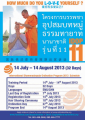
International Dhammadayada Ordination Program 2013
HOW MUCH DO YOU L-O-V-E YOURSELF ?
看您有多爱自己?
โครงการบรรพชาอุปสมบทหมู่ธรรมทายาทนานาชาติ IDOP รุ่นที่ 11
国际佛法新传者短期出家活动
14 July – 14 August 2013 (32 Days)
International Dhammadayada Ordination Program 201
The International Dhammadayada Ordination Program (IDOP) offers a unique opportunity for individuals to experience monastic life. Scheduled from July 14 to August 14, 2013, this 32-day program welcome
10
Ceremonial Gatherings in Monastic Life
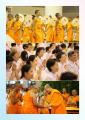
- The first image shows young monks dressed in orange robes, walking in a line, some holding fans or parasols.
- The second image depicts a group of women, most with their hands in a prayer gesture, s
This content portrays the rich traditions and ceremonial gatherings within monastic life, showcasing young monks in their distinctive orange robes, participating in processions. Women in white attire
17
ธรรมหสมเด็จพระสัมมาสัมพุทธเจ้า ที่ 15
ธรรมหสมเด็จพระสัมมาสัมพุทธเจ้า ที่ 15
ชีวิตนี้เท่านั้นที่จะนำไปสู่ความสุขดี
ผู้บริฐานจิตปฏิรูปจะกลับมาเกิดเป็นมนุษย์ พบพระพุทธศาสนานั้น คือผู้รับรองความสำคัญของชีวิตที่ไม่อาจนับน้อยกว่า.......
ชีวิต
ในบทนี้กล่าวถึงความสำคัญของชีวิตนี้ในการบำเพ็ญบุญกุศลและการปฏิบัติธรรมเพื่อให้ถึงมรรคผลนิพพานที่พ้นทุกข์ ผู้ที่มีความตั้งมั่นจะเกิดเป็นมนุษย์และได้พบพระพุทธศาสนาถือเป็นการรับรองความสำคัญของชีวิต ความด
20
Exploring the Existence of Life After Death
'Have you, prince, any further proof to establish that they do not exist ?'
' I have, Master Kassapa. '
' As how ? '
' Here it is, Master Kassapa. I have had friends and companions, kinsmen, men of th
บทสนทนาระหว่างเจ้าชายกับอาจารย์คัสซัปปะ เกี่ยวกับการมีหลักฐานที่ชัดเจนในการพิสูจน์ว่าชีวิตหลังความตายมีจริงหรือไม่ เจ้าชายกล่าวถึงเพื่อนๆ และญาติที่รักษาศีลธรรมแต่ประสบโรคภัยและไม่ได้เกิดใหม่ในโลกที่ส
22
The Simile of the Man in the Mire
Now this again, Master Kassapa, is evidence to me that there is neither another world, nor rebirth other than of parentage, nor fruit and result of deeds well - done and ill - done.'
9. 'Well then, P
In this passage, Master Kassapa uses a simile to illustrate the complexity of existence and moral actions. He compares a man trapped in mire to the wider concepts of life, illustrating that actions, l
34
The Consequences of Greed and Desire
once dead, they will be better off, that they are fond of life, averse from dying, fond of happiness, disinclined for sorrow. This, Master Kassapa, is for me evidence that there is no other world, no
This text discusses the human inclination towards life and happiness while fearing death and sorrow. It presents a simile involving a brahmin with two wives and the devastating consequences of greed w
54
The Boy and the Fire Drill
Then the boy chopped the fire drill with the hatchet, thinking : - " Perhaps that's how I shall get fire." No fire got he. He split the fire drill in twain, in three, four, five, ten, a hundred pieces
In this tale, a boy attempts to create fire by chopping a fire drill with a hatchet, smashing it into pieces, and using a mortar. Despite his efforts, he fails to produce any fire. The Jatila returns
68
This Life Next Life: The Gambler's Tale
This Life Next Life
In anger thereat will I keep to it. In guile will I keep to it. In self-respect will I keep to it!!
27. 'Well then, Prince, I will give you a smile, for it is by way of a smile t
This text recounts a fable involving two gamesters engaged in a game with dice. The first gambler swallows every adverse die, while the second deceives him by using poisoned dice. This tale serves to
199
ธรรมศิริสูตร
3.1.10.2. ธรรมศิริสูตร
คำบรรยายนี้เป็นพระสูตรมหายานขนาดสั้น รวมรวมหัวข้อธรรมที่นำไปสู่การตรัสรู้หรือธรรมที่เป็นผลจากการตรัสรู้ (Kumamoto 1995) พบคำบรรยายเป็นภาษาสันสกฤตทั้งในตอนเหนือและตอนใต้ของเอเชีย
ธรรมศิริสูตรเป็นพระสูตรมหายานขนาดสั้นที่รวบรวมหัวข้อธรรมที่นำไปสู่การตรัสรู้ พบคำบรรยายทั้งในภาษาสันสกฤตและภาษาไตนบรรณ รวมถึงภาษาจีน โดยมีการคัดลอกในช่วงพุทธศตวรรษที่ 12-14 ข้อมูลที่ศึกษาในงานวิจัยนี้
558
หลักฐานธรรมาภายในคัมภีร์พุทธโบราณ 1 ฉบับวิชาการ
หลักฐานธรรมาภายในคัมภีร์พุทธโบราณ 1 ฉบับวิชาการ
บรรณานุกรมภาษาอังกฤษ
Allon, Mark. 2008. "Recent Discoveries of Buddhist Manuscripts from Afghanistan and Pakistan and their Significance." In K. Parry
เอกสารนี้นำเสนอหลักฐานธรรมาภายในคัมภีร์พุทธโบราณที่สำคัญ โดยมีการอ้างอิงถึงงานวิจัยและการศึกษาเกี่ยวกับเอกสารทางพระพุทธศาสนา ซึ่งช่วยเสริมสร้างความเข้าใจในปรัชญาของพุทธศาสนาในแง่มุมต่างๆ การศึกษาเหล่า